

Portland’s greatest opportunity for a better future is hiding in plain sight.
Taking it on will take some brass. We would need to question long held beliefs and go against the grain. Maine folks are, sometimes, great at this. Can we do it?
Imagine if there wasn’t a noisy, dirty, dangerous, ugly, chaotic, expensive freeway dividing our city in half.
Imagine if we revise 2951, redesigning the commuter freeway in Portland as an urban boulevard fully integrated with the city street network. This would be an expanded and possibly even more transformative version of the Reimagining Franklin Street project. Here’s what we’d get:
Reconnected neighborhoods like East Deering and Libbytown would become far safer, calmer, and easier to get around
The Back Cove Trail could get much wider, with acres of land reclaimed for new waterfront park areas
New affordable or social housing could be built on land reclaimed from the medians and off-ramps of the old freeway.
City revenues would increase as buildable land is made available and better suited to high-growth development.
Small and local businesses in the city would benefit from walkability improvements.
Tens of thousands of vehicles that currently save a buck and two minutes by driving through downtown would be re-routed to I-95, reducing unnecessary trips through the city
Flooding risks in Bayside and Back Cove would be mitigated by adding more permeable surfaces and eliminating the bathtub effect of the highway viaduct.
Hundreds of crashes and dozens of injuries and deaths would be averted at the current chaotic exit ramps.
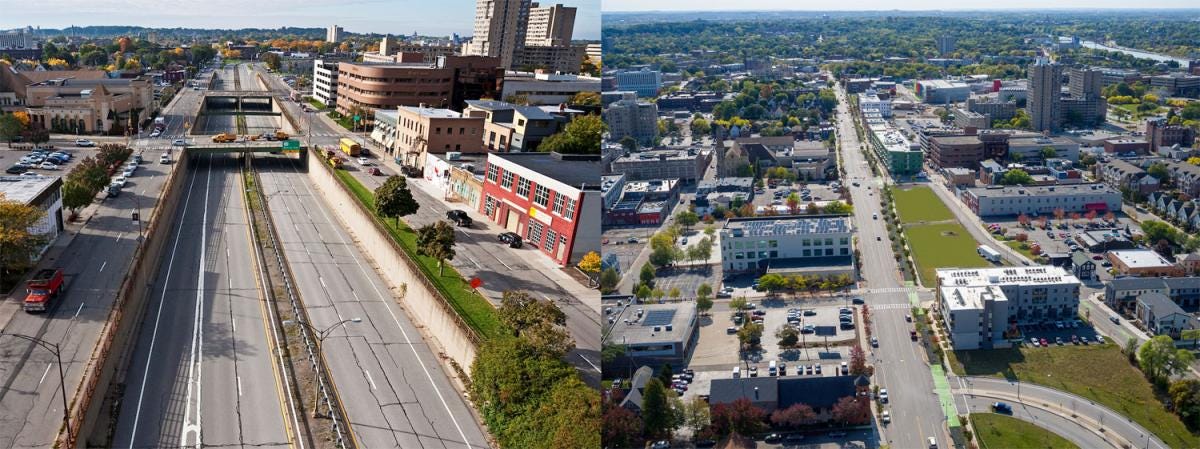
This is not a pipe dream. Other cities have seen these benefits when they convert their inner-city highways to other uses, and the results are clear. In Milwaukee, home values increased 25% around the new boulevard. In Oakland, converting a freeway to a boulevard parkway cut pollution downtown. Rochester, New York converted its inner city loop to a boulevard in 2017. The $22 million project led to $229 million in real estate development, and the city is considering expanding the highway removal campaign.
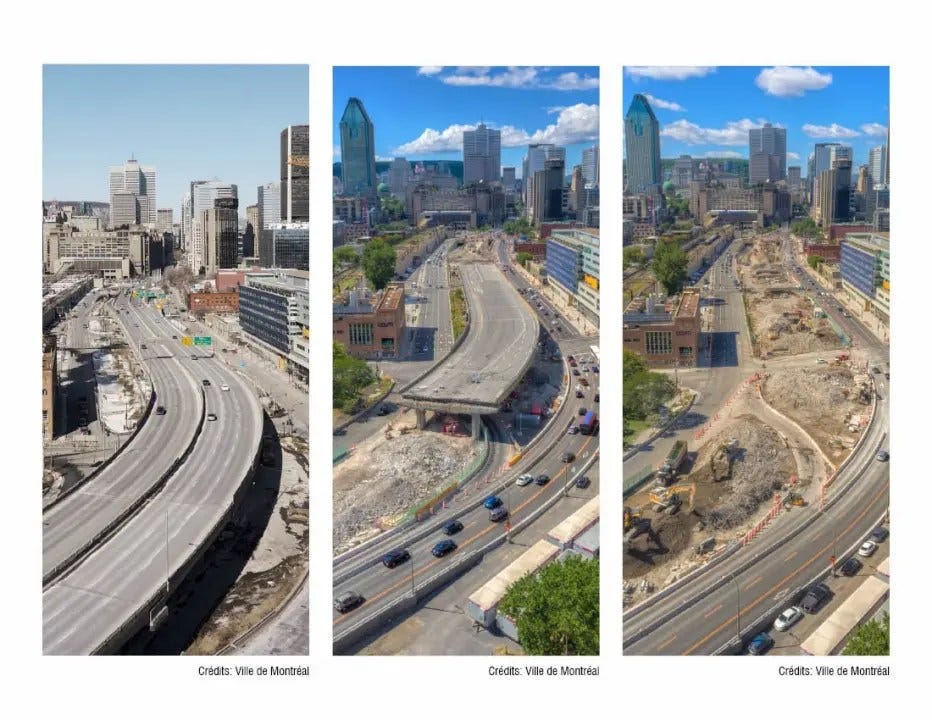
In Somerville, Massachusetts, Mass DOT is dismantling the McGrath Highway and converting it to a ground-level boulevard. The city’s aggressive Vision Zero program has already eliminated pedestrian deaths in the city for four years running.
No, converting 295 to a boulevard won’t cause carmaggedon
Current traffic counts are close to what a four-lane boulevard could handle, even using traditional traffic modeling. If you consider the traffic in a complex system, the picture looks even better.
As much as 30% of the vehicles on I-295 are through traffic which was intended to route around the city on the Falmouth Spur of the Maine Turnpike. Those drivers opt for I-295 because GPS says its a minute or two longer, and because some of them get to skip the MTA’s $1 toll. Those drivers will change behavior if conditions change.
We underestimate the amount that the limited-access highway screws up trips within the city. If Tukey’s Bridge ended in a half dozen direct, convenient routes to the East End, then Franklin Street would not be the car sewer that it is. Reconnecting many neighborhoods will add some number of cars to each, but make us all safer, healthier, more connected, and give us more freedom of choice for travel within the city overall.
Cutting-edge research into road diets and highway removals has found that reducing freeway capacity actually reduces demand. Drivers choose to work from home, travel at off-peak hours, take transit, or move closer to their destinations. Some estimates are that the reduced demand is equal to the amount of roadway reduction.2
295 accelerated the sprawl that stagnated Portland for decades
Before I-295, Congress Street was still the premier shopping district of the entire state. Tukey’s bridge was built in 1960, initially ending at Marginal Way on the Back Cove waterfront. In 1971, the authorities completed the 3 miles of highway through downtown, and the same year, Sears opened at the Maine Mall.
Over the next two decades, the city’s bustling downtown was hollowed out. Sprawling bedroom suburbs moved out along the new highway to Falmouth, Cumberland, Yarmouth, Freeport, and beyond. Suddenly, tens of thousands of cars were driving into the city every day. Hundreds of brick buildings throughout downtown were bulldozed to make space for parking. The city’s downtown population collapsed, which undermined businesses that relied on residents as customers and workers. Portland’s downtown used to be alive with people shopping, strolling, working, meeting, building, and just being. The loss of homes, jobs, and residents downtown has accelerated our homelessness crisis, as well.
To make Portland fully walkable, we must Revise 295
Hundreds of crashes per year are directly attributable to having an interstate highway spilling out our city streets. Vehicles driving at 60 mph or more on a cars-only, wide highway do not smoothly transition to driving 25 mph through neighborhoods and yielding to pedestrians. Many of our highest-crash locations are around the exit ramps from the highway, where merging high-speed vehicles are hitting pedestrians, cyclists, and other drivers.
Maine DOT’s traffic engineers exercise veto rights over any aggressive safety project the city might implement around I-295. Major safety projects in the pipeline will transform safety for most of Washington Ave, Forest Ave, and Franklin Arterial, except near I-295, where the stroad conditions will remain.
If 295 were a right-sized boulevard, Diane Bell would be alive today, and probably many others.
If we don’t revise 295, there will be more victims of road violence like Diane Bell.
As a boulevard, the corridor will be slower and safer to travel on or across for all users. It would support a far more functional mass transit service than a highway, as stops can be integrated into the street design.
No one regrets removing these things after they’re gone. When we finally revise 295, we’ll wonder why we waited so long.
I’m hardly the first person to call for an end of 295 as it is today. Soon after I moved back to town in 2022, I found a small community of folks working on this concept, including Zack Barowitz, Liz Trice, and others. Credit for the “Revise 295” tagline goes to Maya Lena, a city school board member, mom, and fellow safe streets advocate.
This makes sense, as it’s the intuitive inverse of the thoroughly evidenced theory of induced demand.
Is there a proposed map or drawing of what this might look like?
And in the meantime, what about a significant toll for through users of 295?
I am very open to this but would like to see the details more fleshed out. For example, I live in the East End - how would I get to my doctors appointments in SoPo near the mall or are we assuming that those suburban medical facilities would move back into town? Also one of the main reason we don’t have more year round residents on the Peninsula is that most of the housing that has been built in the last 10 years has been luxury condos for part-time residents. Those huge condo buildings on Franklin are mostly empty in the winter. That doesn’t help our local commerce. Our Munjoy Hill Rosemont is sorely missed but had to close because there are no longer enough year-round residents. Too many snow-bird condos and airbnbs instead of the affordable housing that was always the fabric of Munjoy Hill before the last 15 years.